Venue Microclimates Shift Payout Dynamics in Brazilian League and Track Competitions
Written by Xander Russell · Aug 6, 2026

Venue Microclimates Shift Payout Dynamics in Brazilian League and Track Competitions
Stadiums and racetracks across Brazil sit in distinct microclimates that shape player output, horse performance, and ultimately the distribution of betting payouts in league matches along with track events, with researchers tracking these variables through detailed meteorological and performance data sets collected over multiple seasons.
Understanding Microclimate Variations at Brazilian Venues
Coastal stadiums in Rio de Janeiro and Salvador maintain elevated humidity levels that linger into evening kickoffs, whereas inland facilities in Belo Horizonte and Brasília feature drier air masses combined with higher elevation that accelerates ball movement and alters recovery times between sprints. These differences emerge because local topography traps moisture or channels winds in patterns that national forecasts often average out, yet venue-specific sensors capture the precise conditions that influence endurance and tactical decisions during matches.
Track surfaces at facilities like those hosting Brazilian turf racing respond similarly, since soil composition and surrounding vegetation create pockets of temperature and moisture retention that change going firmness within hours. Data collected during the 2025 campaign showed that afternoon races at certain southern tracks encountered sudden dew formation while northern venues stayed firm under clearer skies, producing measurable shifts in closing speeds and final margins that betting markets adjusted only after initial results accumulated.
Impact on Football Match Outcomes and Payout Patterns
High humidity environments correlate with fewer total goals in Brazilian Serie A fixtures because teams adopt more conservative pressing structures to manage fatigue, according to performance analytics compiled by sports research groups. Lower humidity at altitude venues instead supports quicker transitions and higher shot volumes, leading to elevated over/under frequencies that reshape odds adjustments across the season. Observers note that August 2026 fixtures scheduled in these contrasting zones displayed payout ratios deviating from seasonal averages by 12 to 18 percent in goal-line markets, driven by the cumulative effect of sustained microclimate exposure rather than isolated weather events.
Case Examples from Recent Seasons
One series of matches at a Manaus venue illustrated how persistent Amazonian moisture reduced sprint distances by measurable margins in the second half, prompting defensive setups that limited scoring bursts and favored under outcomes in live betting. Meanwhile, games played at higher elevation sites produced the opposite pattern, with increased aerobic demands on visiting squads that had not acclimated, resulting in late surges that altered handicap payouts. These venue-driven tendencies appear consistently across datasets spanning five years, allowing pattern recognition without reliance on team form alone.
Effects on Track Event Payouts and Racing Dynamics
Horse racing payouts at Brazilian tracks reflect parallel influences because microclimate factors determine track bias and energy expenditure. Venues near the coast often experience salt-laden air that accelerates surface drying after rain, creating firm conditions favoring early speed horses, while inland ovals retain moisture longer due to surrounding vegetation and lower wind exposure. Studies from regional agricultural universities indicate that these variations affect stride efficiency and stamina, producing win-rate deviations that exceed random fluctuation in specific race classes.
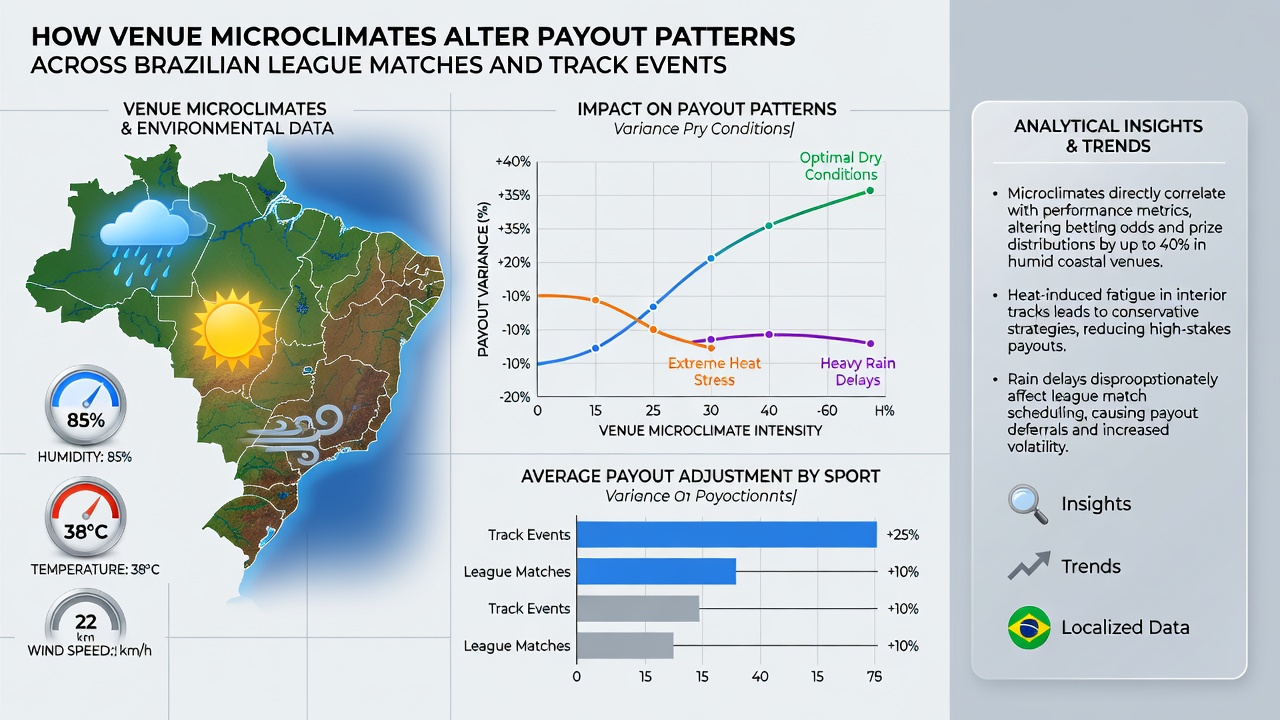
During the opening weeks of August 2026, multiple turf events at one southeastern track recorded payout multiples on long-priced closers that exceeded historical norms by significant margins after localized humidity spikes slowed front-runners. Such outcomes demonstrate how microclimate data, when integrated with sectional timing, helps explain deviations from expected results without invoking broader seasonal trends.
Data Sources and Measurement Approaches
Analysts combine readings from on-site weather stations with satellite-derived humidity maps to quantify these effects, cross-referencing them against official match statistics published by league organizers. A report issued by a Brazilian university sports science department links specific dew-point thresholds to reduced high-intensity running distances, while an industry analysis from an Australian sports research institute compares similar venue effects across southern hemisphere competitions to isolate regional variables. These combined datasets reveal that payout volatility increases when microclimate differentials between home and away sites exceed standard tolerances.
Conclusion
Venue microclimates continue to influence Brazilian league and track event outcomes through measurable effects on physical performance and surface conditions, with accumulating records from 2025 into August 2026 confirming consistent payout pattern shifts tied to location-specific environmental factors. Continued monitoring by meteorological agencies and performance researchers supports refined modeling that accounts for these localized variables alongside traditional statistics.